Met de opkomst van het 5G‑bigdata‑tijdperk, de evolutie van netwerken en de snelle ontwikkeling van de data‑industrie, wordt de omvang van grote datacenters (DC) steeds groter, en neemt ook het stroomverbruik van datacenters toe. Volgens statistieken bedroeg het nationale stroomverbruik van datacenters in 2018 160,889 miljard kW/u, waarmee het het totale stroomverbruik van Shanghai in 2018 overtrof en goed was voor 2,35% van het totale stroomverbruik van China. Bovendien wordt verwacht dat dit in 2023 zal stijgen naar 266,792 miljard kW/u; de gemiddelde jaarlijkse groei zal dan 10,64% bedragen, wat ongeveer gelijk staat aan de opwekkingscapaciteit van 2,5 Drieklovende‑dammen.
Wat nog belangrijker is: het stroomverbruik is uitgegroeid tot een knelpunt dat de ontwikkeling van datacenterdiensten beperkt. De onderstaande tabel toont het aandeel van het energieverbruik per systeemconfiguratie in het datacenter. Uit de analyse van de gegevens in de tabel blijkt dat bij het niet‑IT‑energieverbruik ongeveer 63% van de verliezen wordt veroorzaakt door het koelsysteem van het datacenter.

In response to the high energy consumption of the data center cooling system, various energy-saving solutions have been tried in the industry. At the result, Indirect Evaporative (IEC) is one of the most promising cooling solutions.
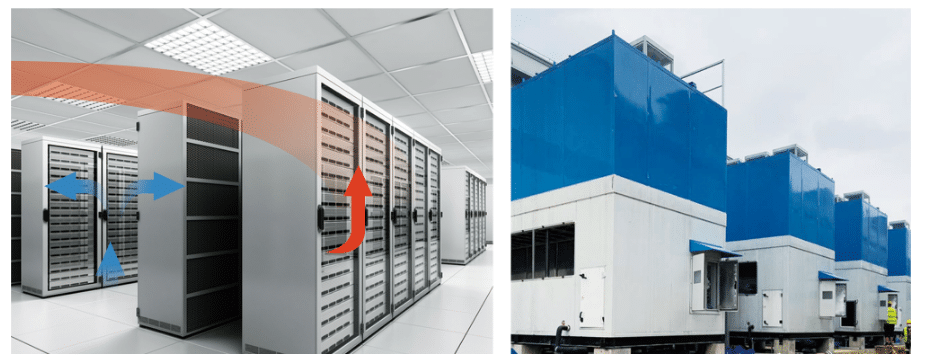
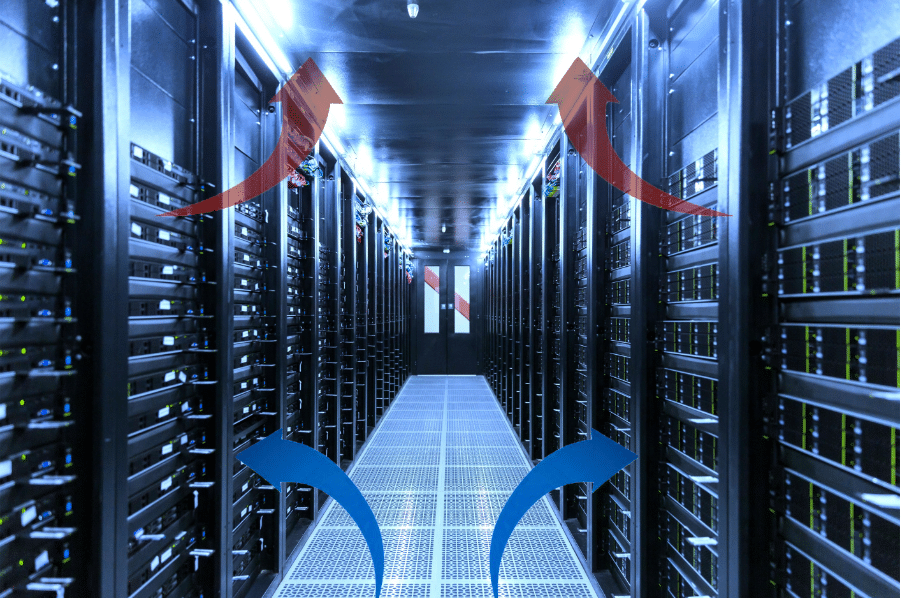
The following figure shows the working principle diagram and product structure diagram of indirect evaporative cooling system.
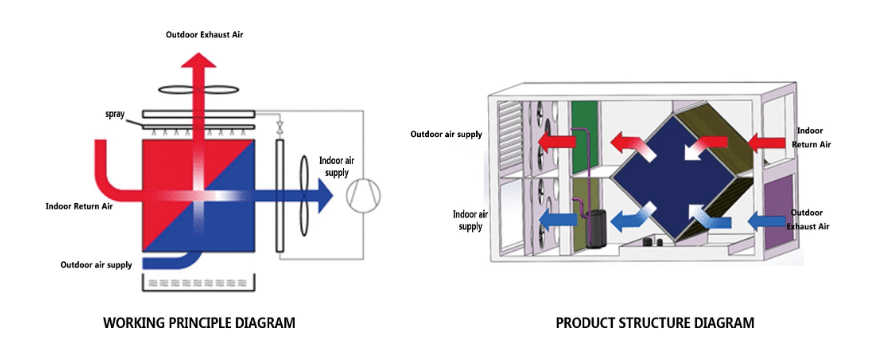
The indirect evaporative cooling system mainly includes three core components: plate heat exchanger, spray system, and compressor supplementary cooling system. During the cooling process, the air to be treated inside the data center passes through the air heat exchange device. Firstly, the outdoor air is used to cool the closed indoor air. At the same time, the spray system spray water uses the heat of the outdoor air to evaporate in the plate heat exchange device. Absorb heat to reduce the temperature of the air to be processed. As the result, making cool the circulating air inside the DC to the greatest extent. Throughout the process, indoor air is a closed loop system, while outdoor air is an open system. Outdoor air does not allow enter the DC, thus preventing moisture and pollutants in the outdoor air from entering the DC. Since the treated air does not directly contact with water, its moisture content remains unchanged, realizing isohumid cooling of air.
Operating mode
Depending on the outdoor temperature, the Evaporative Cooling Air-conditioning can adopt three operating modes.

Taking a single set of system (selecting BXB2000-2200-12.0 plate heat exchanger) as an example, the selection calculation shows that compared to a pure refrigeration and air-conditioning system, adopting an indirect evaporative cooling system. The air sensible plate heat exchanger can recover 194kw per hour. Spray system can absorb 686kw of heat, and recover a total of 880kw of heat. It can be seen that the use of an indirect evaporative cooling system can save 352kw*h of electricity per hour for the evaporative cooling system, and the energy saving effect is significant.
Case show